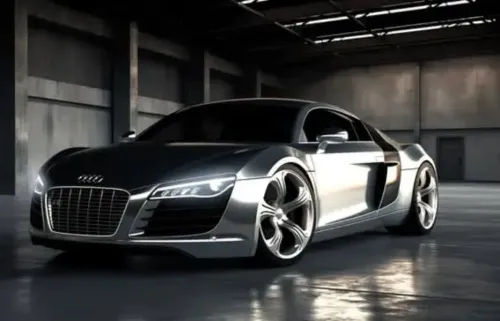
The **Audi R8 e-tron** is a significant milestone in Audi's electric history, though it was never a mainstream model. It was Audi's first series-production battery-electric vehicle (BEV), but it was built in extremely limited numbers and was eventually discontinued.
### 🔋 The First Electric R8 (2015-2016)
The production version of the R8 e-tron was revealed at the 2015 Geneva Motor Show. It featured a **T-shaped, 92-kWh lithium-ion battery** that was bolted to the structure at 40 points, functioning as a supporting element that increased rigidity. Power came from **two electric motors on the rear axle**, producing a combined output of **456 hp and 920 Nm of torque**. This allowed it to accelerate from 0-100 km/h in **3.9 seconds**, with a top speed limited to 210 km/h and a claimed range of **450 km**.
### ⚡ Performance and Engineering
The R8 e-tron was a technical showcase. It featured **electric torque vectoring**, where the two rear motors could brake or power individual wheels for sharper cornering. It also used lightweight engineering, including **glass-fiber reinforced plastic (GFRP) springs** that weighed only about 1.2 kg each—roughly 40% less than steel. The car had a **drag coefficient of 0.27**, helped by active aero wheels with carbon flaps that closed above 50 km/h.
### 📉 Discontinuation and Rarity
Despite the advanced engineering, the R8 e-tron was **discontinued in 2016** after less than a year on the market. The reason was its **astronomical price tag of approximately €1 million** and its limited range compared to gasoline supercars. Fewer than **100 units** were ever built, and it was never listed in Audi's online configurator. Audi confirmed that its BEV strategy was shifting toward high-volume models like the e-tron SUV.
### 🔮 The Future: R8 E-tron (2027)
The R8 e-tron name is set to return in a completely different form. According to reports, a **new R8 E-tron is expected around 2027**, and it will be a **plug-in hybrid**, not a pure EV. It is rumored to share a **4.0L twin-turbo V8 and three-motor hybrid system** with the Lamborghini Temerario, producing a combined **920 horsepower** and accelerating from 0-100 km/h in just **2.7 seconds**. This represents a shift from pure electrification to hybrid performance for Audi's flagship supercar.
### 🔋 The First Electric R8 (2015-2016)
The production version of the R8 e-tron was revealed at the 2015 Geneva Motor Show. It featured a **T-shaped, 92-kWh lithium-ion battery** that was bolted to the structure at 40 points, functioning as a supporting element that increased rigidity. Power came from **two electric motors on the rear axle**, producing a combined output of **456 hp and 920 Nm of torque**. This allowed it to accelerate from 0-100 km/h in **3.9 seconds**, with a top speed limited to 210 km/h and a claimed range of **450 km**.
### ⚡ Performance and Engineering
The R8 e-tron was a technical showcase. It featured **electric torque vectoring**, where the two rear motors could brake or power individual wheels for sharper cornering. It also used lightweight engineering, including **glass-fiber reinforced plastic (GFRP) springs** that weighed only about 1.2 kg each—roughly 40% less than steel. The car had a **drag coefficient of 0.27**, helped by active aero wheels with carbon flaps that closed above 50 km/h.
### 📉 Discontinuation and Rarity
Despite the advanced engineering, the R8 e-tron was **discontinued in 2016** after less than a year on the market. The reason was its **astronomical price tag of approximately €1 million** and its limited range compared to gasoline supercars. Fewer than **100 units** were ever built, and it was never listed in Audi's online configurator. Audi confirmed that its BEV strategy was shifting toward high-volume models like the e-tron SUV.
### 🔮 The Future: R8 E-tron (2027)
The R8 e-tron name is set to return in a completely different form. According to reports, a **new R8 E-tron is expected around 2027**, and it will be a **plug-in hybrid**, not a pure EV. It is rumored to share a **4.0L twin-turbo V8 and three-motor hybrid system** with the Lamborghini Temerario, producing a combined **920 horsepower** and accelerating from 0-100 km/h in just **2.7 seconds**. This represents a shift from pure electrification to hybrid performance for Audi's flagship supercar.
Keywords